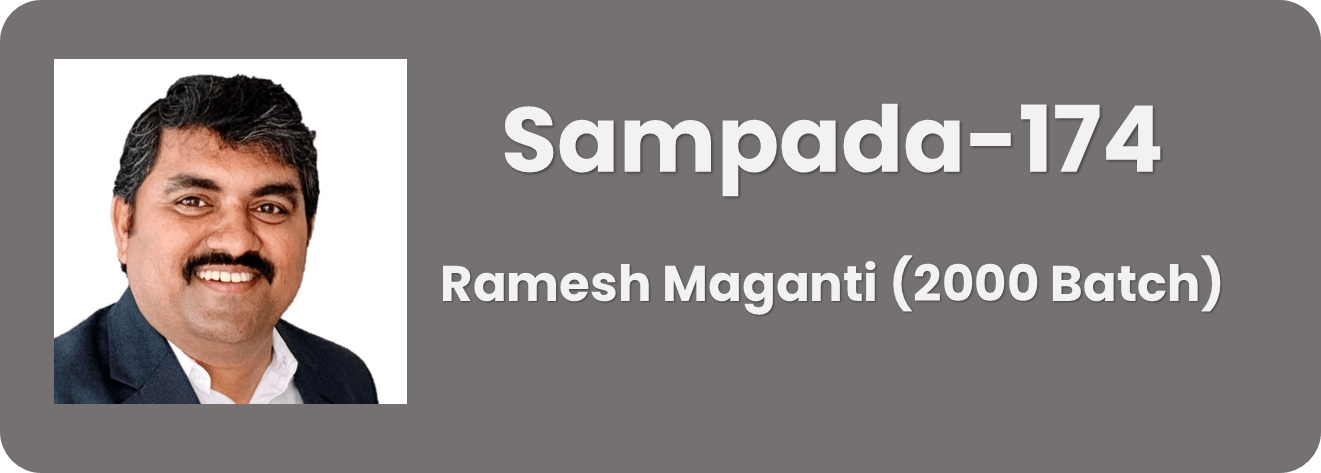
Team Sampada: Our readers would like to know about you and your profile in detail. Could you please elaborate a bit?
Ramesh Maganti: I’m a Civil Engineer with an MBA, certified by Symbiosis, Executive business MBA from Cornell Tech (USA) and various certifications on Project management like Keppner tregor Project management certification which speaks of my business acumen and deep understanding of the subject. I am a Member of Institute of Engineers, Indian Concrete Institute, CII and have been active member in the field of Civil Engineering working closely with academia such as IIT Madras, IIT Bombay and IIT Guwahati.
I have co-authored a book on first book on Industrial floors under the ICI Umbrella – TC/07 which was developed in collaboration with IIT Madras. I have also worked with various organisations over the last 2+ decades and at multiple capacities in the fields of Contracting, Procurement, site execution and overall management of projects across various locations including India and countries such as Bangladesh, Sri Lanka, Nepal, Cambodia, Vietnam and UAE to name a few. I have worked as Infrastructure head for India operations and as Asia pacific head for Global operations for Coca-Cola, have worked previously with ITC, part of the team which developed the first largest Business park – Ecospace for RMZ Corp to name a few.
I draw inspiration from the great Civil Engineer Sir M Visvesvaraya and has been a innovator, working with newer technologies and has always enjoyed working closely with teams and leveraging the strengths of the teams to provide long lasting solutions. Driving problems to solutions has been my forte in more than 2 decades of my active work Life.
TS: Can you share some challenges that you faced in your 20+ years of experience in this domain?
RM: Challenges are part of the life of an engineer. To name a few: Foundation was designed with end bearing piles, at a later stage where there was a big void below the ground at 12m level. The foundation required a change and it would impact cost and timelines. The impact of change would cost the company in excess of 16 Cr and it was resolved with collaboration with academia and the overall impact was reduced to 2 Cr.
TS: Now you are wearing the cap of an Entrepreneur. Could you elaborate a bit more, since many of our readers would like to know about it.
RM: Now that I have worked for over 2 decades in active work life as an employee, entrepreneurship has been a good run. Entrepreneurship has allowed us to explore different industries, increased the horizon of engineering expertise that can be applied for various applications and locations and also brought us close to the reality that the industry is moving towards. It has allowed a lot of freedom to experiment with progressive applications and push the envelope of innovation and development to reduce dependency on labour, move towards faster pace of construction.
TS: To the current students from Civil background, what would be your suggestions? There are lot of concerns about the placements, future etc and we will be grateful if you share some insights based on your experience.
RM: The future of a civil engineer is always secured. More important is to be true to the knowledge that they have gained over the 4 years of studies. A few attributes that would be required for students coming out fresh from college would be to have learning mindset to learn, not just civil engineering but understand the connecting details of all disciplines of HVAC, Electrical, instrumentation, fire and Plumbing services, specific process requirements, utility requirements like boiler, compressors.
First 8-10 years be ready to go through the grind. Work hard, learn and question everything they see and come out with options to work faster, better in speed and quality which are paramount for any engineer working on projects. I would bring in more emphasis on learning the practical aspects of projects. Each project is unique and hence gives ample opportunity to learn. I would personally discourage students from joining large organizations as the opportunity to learn is limited and hence would look at students to learn small to medium sizes organizations so that they try their hands at various aspects of the project, including client brief, master planning, bidding, project costing, tendering and contracts, financial planning and financial viability, on ground execution, challenges at site, project close out, de-snagging and handing over to operations.
It is important for budding engineers to complete a full circle of project start to end to understand various challenges, expectations of customers, stakeholders and understand the impact the project does on the company. Active interactions and engagement with consultants, engineers and vendors will make a person rounded to understand the project in full detail which will set them on a path of more discoveries which will shape the way the engineers understands, designs and executes the project in the future.
This sort of rounded development is critical for a Civil engineer to build a flourishing career for himself and contribute to the development of self, company and country at large.


Leave a comment