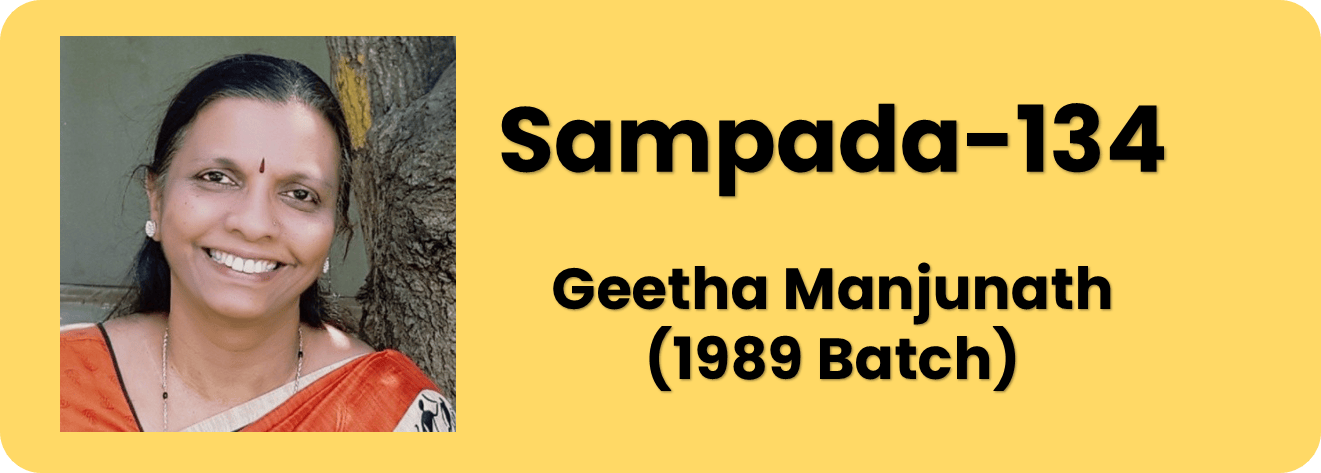
Team Sampada: To get our audience acquainted, please could you introduce yourself
Geetha: I am Geetha, Founder and CEO of NIRAMAI Health Analytix, a deeptech startup where we have developed a novel AI-based solution for detecting early stage breast cancer in an affordable, accessible and privacy aware manner. I did my BE from UVCE, Master and PhD from Indian Institute of Science. I have over 25 years of experience in industry in innovation leadership roles spanning across Hewlett Packard, Xerox Research and C-DAC.
TS: From BE in UVCE to Ph.D at IISc, how was your academic experience ? Could you please tell us how were those days?
Geetha: My first encounter with a computer was in an exhibition where I was fascinated by the automation it enabled. I wanted to know more and so had taken a small course in programming during my exam breaks in junior college and really loved it. When I did get an opportunity to choose between Engineering and Medical, my liking was towards computer science and engineering and my top choice was UVCE. Though a small class, I had excellent classmates and we were like a close knit family. We had such sincere professors and mentors, that I used to enjoy every class with full attention. After flying out of UVCE with rainbow colours, namely topping the state across all branches, I landed at IISc to do my Masters in Computer Science. IISc experience was very different but I did very much enjoy the grilling academics.
I got introduced to some deep research and excellent scientists and professors of whom I was very respectfully fearful of. Thanks to lots of project work, varied assignments, tough exams to crack and excellent guidance from professors, I became very fond of research and decided to choose my career as a researcher. I joined my dream job of C-DAC to be part of the team building first supercomputer from India. I went back to do my PhD at IISc as an external registrant after 15 years of my work experience across Hewlett Packard Labs and C-DAC. I chose to pick up a topic that I had not worked upon in the industry until the, and decided to work on the then upcoming field of Data Mining and was fortunate to get the guidance of Prof M Narasimha Murty Sir and Dr Dinkar Sitaram for my PhD. Doing academic research in parallel to regular job was extremely hectic, but I am glad I did it. The machine learning fundamentals that I learnt during those days are still keeping me going at Niramai.
TS: What are some of your most favourite memories of UVCE?
Geetha: When I joined UVCE, I was a shy girl and hardly talking to any of my male classmates. As we were just second batch of CS students, It was a small class and everyone knew each other. The excellent faculty at UVCE made me love computers even more and got me intrigued with the internal of the same. Professors like Venugopal Sir, HNS, AVR, Since computer era was just starting up at that time, our college had restricted access to computers. We used to have computer labs twice a week and two of us had to share one computer even during those lasses. How time changes. Now, it has become so common for every person in the family to have more than one computer and every mobile is more powerful than a workstation we were waiting to get access to at that time. We also had a lot of fun at UVCE. I still remember the Kamat hotel and Nisarga hotel which we would visit so often when we stayed back in college in the pretext of special classes and combined studies. I also vividly remember our class trip to Mangalore in rainy season and the whole class watching a late night movie in a theatre nearby. I don’t remember which movie it was but do recall having a gala time, disturbing the audience by making open loud comments on the movie.
TS: You have been a core part of Research in the Industry, worked in companies like HP and Xerox to leading your own company. Can you please shed more light on how your professional journey has been so far?
Geetha: I joined C-DAC right after my Master’s at IISc. It was my dream job as I did not want to go abroad but wanted to do research. C-DAC was the only place where systems research was being done at that time. Really enjoyed the company of another excellent team where we had passionate discussions, lovely trips and friendly lunches. When I felt that the tech innovation content in the work is reducing, Hewlett Packard contacted me as they were starting their first research team in India. I loved the job role as it involved proposing new ideas, implementing prototypes and presenting the new work in front of researchers to get feedback. It also involved a lot of travel abroad where I got to meet and learn from international researchers. I began to love research that made an impact on the ground. That was a transformation – since till then I thought anything to do with application development as lower than systems research. I realized how fulfilling it was to see technology solve a real problem on the ground, rather than staying in publications. I started proposing new product ideas that had business impact. I also got an opportunity to present some of those ideas to the global CTO and also got funded to explore multiple such ideas and converted them into products adjacent to HP business. I joined Xerox Research in 2013 when HP Labs decided to close down their Bangalore research lab. At Xerox, I was a senior manager leading Data Analytics research for India and working with some brilliant team members to propose and lead multiple projects aimed at the future of the company. In addition to mentoring researchers, I had the opportunity to interact with several business leaders and potential customers and learn how to fine tune an idea or product to suit the requirements of business/customers.
TS: What made you start and lead Niramai Health Analytix? What challenges according to you do entrepreneurs (esp women entrepreneurs) face growing in the industry ?
Geetha: When I was in corporate R&D working with business leaders & customers to develop some new solutions for the transportation and healthcare segments, one of my close cousin sisters was detected with breast cancer. I was shocked and started reading up about breast cancer and figured out that there was a great gap in the offerings. Working with my colleague and imaging expert Dr Mestha, and with the blessings of my manager Dr Manish Gupta, we started a project to explore use of thermal images for cancer detection. After seeing a few images and collaboration with hospitals, I thought that can be a good usecase for computer vision and machine learning. Along with a small dedicated team of researchers, we developed a small prototype to try this out. I thought the work could be further enhanced and made to go on the ground to save many lives. So, I quit my job & started Niramai along with Nidhi, Himanshu and Sivateja, starting 1 Jan 2017.
Its been a great learning over the last 4 years. Entrepreneurial journey has a lot of ups and downs. One needs to stay focussed on the solution to the problem that they want to solve, be optimistic and keep the perseverance without getting bogged down by everyday issues. Being a woman founder, makes it slightly harder since we have to multiple worlds to manage – kitchen, family, work team, customers, partners, investors etc. Since there are very few women in this ecosystem, it is also difficult to network with people and many times gender comes in between friendship.
TS: In what ways do you think namma UVCE should focus to bridge the gap between academia and industry? What is your advice to our current UVCE students?
Geetha: I think UVCE continues to be the Gem of Karnataka – a go to place for bright students. Along with academic excellence, I think there should be more focus on hands-on-projects where students get to work on real life problems starting from their second year of engineering itself. . This could be in the form of internships in industry or local Centres of Excellences. Professors can identify their area of interest and form research units in those areas and create collaborative projects with industry where these projects can be executed at the institute as well. Regular hackathons can be conducted within the college to give an opportunity for students to practice problem solving. Secondly, there should be more encouragement for creative thinking and entrepreneurship. This could be in the form of additional course work, invited lectures from entrepreneurs & assigning industry mentors to students have their own ideas to pursue. Small funding can be provided to build innovative prototypes, organize idea fests to create a competitive spirit & nurture innovation.
My advice to current students is : Enjoy this learning phase – Its fun to study just with an intent of understanding the concepts and not for the sake of exams. India has several problems and challenges. Look around and pick any real life problem that you feel for and try to solve it in your own way. There is a lot of satisfaction in doing so – & India needs such smart people today!


Leave a comment