
Team Sampada: Can you please give a brief profile about yourself for our readers?
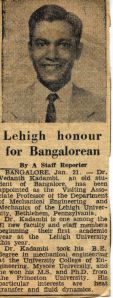
Vedanth Kadambi: Native Bengalurian. Attended National College and then Govt Engineering college which is now UVCE. Graduated in 1956 in the Mechanical Engineering discipline and after a year at Indian Institute of science went to Princeton University in the United States and completed a MS and PhD in Mechanical engineering with a thesis in Heat Transfer. After graduating in 1961, joined AT&T Bell Telephone Laboratories and was part of the team that was working on the Telstar 1 satellite launched by NASA in 1962. Joined IIT Kanpur as a member of faculty in the Mechanical Engineering Department at the suggestion and recommendation of my PhD thesis advisor, Dr.Robert M. Drake who was part of the team of the consortium of U S educational institutions assisting in the setup of IIT Kanpur. For a sabbatical, went to Lehigh University in Bethlehem, PA in 1969 as a Visiting professor in the Mechanical Engineering department and on return to IIT Kanpur, went on to become Head of Department of the Mechanical Engineering department. During tenure at IIT Kanpur, helped develop courses, wrote several technical papers and authored textbooks in refrigeration and air conditioning and Introduction to Energy Conversion, a three volume series with the then graduate student, Sri. Manohar Prasad. In the autumn of 1974, left IIT Kanpur and returned to Lehigh University as a member of faculty. Later joined General Electric Co in their Research And Development group in Schenectady, NY, worked at Textron Lycoming and Honeywell International in their Power Systems divisions. Upon retirement from the industrial sector, returned to IIT Kanpur as a honorary visiting professor for a couple of semesters and also was part of the visiting faculty of the newly opened IIT Gandhinagar in Gujarat for a couple of years. Now retired from active careers and exploring life as it happens.
TS: What are your most fond memories of your time at UVCE? Can you please share some of the faculty members related details?
VK: A lot of memories are too foggy to remember in detail, but there are recollections of a faculty member who was a tyrant in making sure we did our carpentry tasks to perfection in our first year at the college; there are memories of the teachers instructing the survey classes, most students wanting to “ survey “ the area in front of the Maharanis college across the street. All the teachers were sincere and dedicated and very thorough in their teaching. My interest in mechanical engineering was a result of listening to the dedicated teachers.
TS: How was Bangalore in those days. How was the journey from here to Lehigh?
VK: Bangalore in those days was a quiet, beautiful town lined with tall trees everywhere, where we could bicycle or walk, lots of parks, several little restaurants & eating places where students with limited budgets could get a decent meal. I frequented the areas around Basavanagudi, where I often stayed at my maternal grandfather’s home. He was a retired chief engineer, Diwan Bahadur Sri. K.R Seshachar, who was the first principal of the college.
On the question of the journey to Lehigh University from India, the second time was one of mixed feelings. The decision to leave IIT Kanpur was due to several factors, mostly the lack of safety for families at that time. Political factions on the campus also disrupted the academic stability. What began as a great opportunity to foster and grow a premier academic community appeared to be in jeopardy. As other opportunities in India were scarce and Lehigh beckoned with enthusiasm the journey to pursue research in engineering continued. That was the autumn of 1974.
TS: We know you have switched between academia and the industry and have great understanding of both. Can you share some best experiences from both the worlds
VK : Best experiences in academia included the ability to interact with the enthusiastic students and faculty with diverse backgrounds, knowledge and interests. The ability to help motivate students to pursue a career in engineering and science, mentor students with their research work and teach them innovative skills, develop laboratories that engaged in practical learning was a wonderful experience. Also possible in academia at that time was an opportunity to think, pursue and research interesting ideas and topics without time constraints. Industry also opened up a vast universe of possibilities in research and development, exciting opportunities to solve real time problems and design new technologies. Of course both academia and industry came with their own challenges of interaction with colleagues and peers and as years went by, management of results that looked more at profit and bottom lines became more or less commonplace. Performance measures and productivity are important but the shackles that come with it often impede creativity, innovation and therefore the ability to think critically, observe and think outside the box.
TS: What would you suggest to the current generation of students from UVCE. Please share some tips and advice to our readers.
VK: Not knowing the make up or the inclinations of the current generation of students, it is hard to comment. But what I can share from personal experiences as a student and a faculty member is that it is very important to learn and get a broad understanding of what engineering is irrespective of the specific discipline or specialization at the early years of the engineering program. Getting a broad base is key in all disciplines. Trying to become the next multimillionaire by choosing paths that are not suitable for your mindset is not always the best approach. It is okay to have a multitude of options and not knowing which one is the best for you as a student. Time and learning have a way of showing you what you can and should do. Of course, seeking good dedicated teachers for guidance and mentoring is a must.
TS: As an institute, UVCE has changed a lot in the past couple of decades. With your experience in the academic institutions what are the points that the authorities of (now autonomous) college should consider to regain their glory and prepare for the future?
VK: Getting the flexibility to run as an autonomous institution could be a great blessing. It may be useful to gather scholars of several generations who can share their experience and expertise in designing and implementing the various engineering programs.Attracting the best and dedicated teachers is not easy but possible with time. A motivated, dedicated teacher who can bring excitement to the process of learning is key to the young enquiring mind. A rotating board of trustees who are focused in bringing back glory to the institution is imperative. Of course, this is more easily said than done, but increasingly important in today’s world where there are always people with new ideas and there are many choices for places of learning. Learning processes need to be innovative and integrated so that students can anticipate what is needed in the future which for the most part is an unknown entity. A good grounding in the basics of engineering is essential.
Finally, balancing what makes good sense for India and what is good for the whole world and the universe at large is an art.


Leave a comment