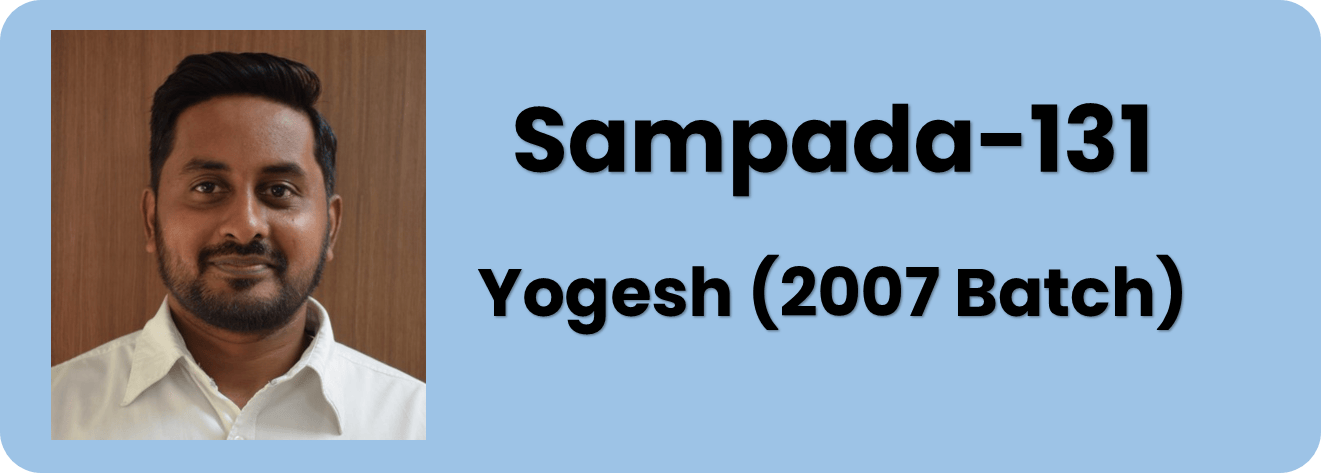
Team Sampada: Can you please tell us about yourself to our readers?
Yogesh: Well, I’m Yogesh, Assistant Engineer, Water Resources Department. Completed Bachelors in the year 2007 and joined the Department in the year of 2009. Although, I have a keen interest in the research field especially water use efficiency in the present situation and future conditions. In 2018, I finished my master’s at IIT Roorkee and am presently appearing for Ph.D. in the stream of Water Resources from the UVCE, Civil Engineering Department. During leisure time, traveling keeps me occupied as a hobby; it is the perfect way to use time, have a break (physically and mentally) from a dull routine. Travel is part of education and part of the experience.
Team Sampada: Can you please tell us about yourself to our readers?
Yogesh: Well, I’m Yogesh, Assistant Engineer, Water Resources Department. Completed Bachelors in the year 2007 and joined the Department in the year of 2009. Although, I have a keen interest in the research field especially water use efficiency in the present situation and future conditions. In 2018, I finished my master’s at IIT Roorkee and am presently appearing for Ph.D. in the stream of Water Resources from the UVCE, Civil Engineering Department. During leisure time, traveling keeps me occupied as a hobby; it is the perfect way to use time, have a break (physically and mentally) from a dull routine. Travel is part of education and part of the experience.
* Advanced Centre for Integrated Water Resources Management (ACIWRM): for implementing Integrated Water Resources Management & capacity building of engineers
* Command Area Development Authority (CADA): for interventions to reduce the difference between irrigation areas created & utilized, engagement with water user co-operative societies
* Karnataka Engineering Research Station (KERS): for technical investigations & studies
* Water and Land Management Institute (WALMI): for water & land management and farmers engagement
An engineer in the WRD will be posted to work in any of the nigams or specialized institutions. WRD provides a plethora of opportunities in action research. Hydrological and Hydraulic modeling are now a decision tool in WRD. Hydrological modelling involves rainfall-runoff modelling, river basin & sub-basin scale modelling to arrive at water accounts and integrated water resources management, climate change modelling to assess the impacts on water resources. Hydraulic modelling is deployed for dam break analysis, flood maps etc. The hydrological data collected by WRD and other departments over a while and real time data gathering has also huge potential for adopting machine learning and artificial intelligence. Openly available Earth Observation datasets are being utilized for more informed decisions in water resources management. WRD is also developing a robust Water Resources Information System for dissemination of information to stakeholders wherein there is scope for software enthusiasts to take their learnings to reach the last mile. Engineers are also encouraged to adoptively engage with stakeholders within the ambit of rules & regulations for water management with focus on equitable distribution.
Team Sampada: How do you think, as common citizens, and also especially as Engineers we can help in water conservation?
Yogesh: Water and cement are extravagantly used things in the world but unfortunately, water cannot be produced. We understand from hydrologic cycle that the water available at any point of time on the earth remains same but the quantum of distribution varies.
Water and related resources are stressed for many reasons including uncoordinated use by different sectors, uncontrolled use, increasing demand and development, and frequent drought. Cape Town, South Africa city almost ran out of water in 2019. According to recent World-Wide Fund for Nature study by 2050, 3 of every 5 very high-water risk cities in the world are from India.
Water conservation should start from one’s home. All shall make a practice of accounting water utilization and optimize unnecessary consumptions. Engineers to emphasize innovative and low-cost technologies for the treatment of fresh and greywater. Water consumption to look in a different perspective from the current demand based to entitlement regime. Data plays a crucial role in water conservation, engineers can disseminate water related information to stakeholders nearby and support them in making informed decisions.
Team Sampada: We would like you to tell us about your career and your roles & responsibilities in detail so that we can create some awareness among the students.
Yogesh: Joined as an Assistant Engineer in Water Resources Department in the year 6449. From 2009-2012 I’ve assisted in the Rehabilitation and resettlement (R&R) Division, Hipparagi Barrage project under Karnataka Neeravari Nigam Limited. Later on, in the year 2012 shifted to Inter-State Waters (ISW) wing, inter-State rivers at the most senior constitutional court, Supreme Court of India up to 2016. And while I enjoyed the work that I did, I’d love the chance to reach the supreme judicial of India. In the year 2016, got an opportunity to pursue Master’s Degree course at Indian Institute of Technology, Roorkee on deputation from the State Government and accomplished in the year 2018. From 2018 onwards working for Advanced Integrated Water Resources Management (ACIWRM). I’ve been in the water resources department for over ten years now.
Team Sampada: Many of the current students will be interested to know about the Govt career opportunities in the sector that you are in. Can you explain a bit about that?
Yogesh: In addition to subject knowledge, a technical job in Government also requires managerial acquaintance. Students shall also have an understanding of stakeholders and their requirements viz., crop and watering requirements in the agriculture sector, water quality in drinking and industrial sector, etc. Recruitment notifications for state government are usually notified by Karnataka Public Service Commission (KPSC) (website: http://www.kpsc.kar.nic.in/) whereas that of quasi-government bodies such as boards, corporations, nigams & societies are done by the bodies themselves. All recruitment notifications will be published in the leading newspapers and through websites.
General studies and current affairs of the State are also a pre-requisite for the recruitment exams. Exam pattern for Junior Engineer posts (diploma holders) & Assistant Engineer posts (degree holders) is a broadly objective type consisting of two papers viz., subject paper and general studies followed by the personal interview. Exams for Asst. Executive Engineers post (degree holders) will be of theoretical subject paper, general studies followed by personal interview.
Students to note that on an average the minimum time for completion of recruitment process i.e., notification to declaration of results may take up to one year and sometimes even more.!. Further reporting to job after declaration of results may take up to 6-month time considering verification requirements.


Leave a comment